

In my research for the film on the School of the Americas (SoA), I learned of another “school” of geopolitical significance during the cold war.
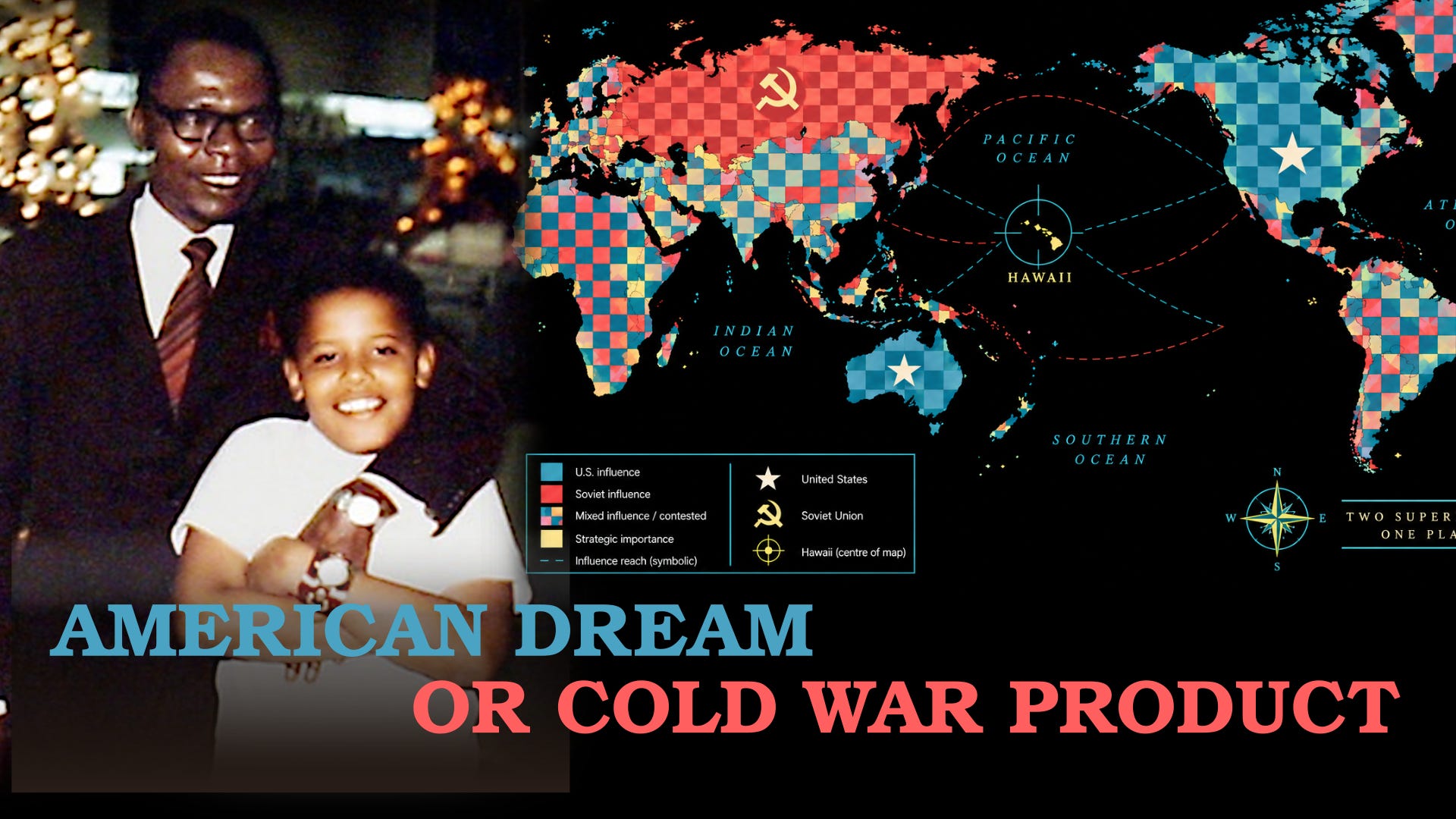
Where the SoA sought control of the Americas through ruthless and violent means, Hawaii’s East–West Center (EWC) was more subtle.
My curiosity was piqued when I learned that Barack Obama’s parents met in a Russian language class at the University of Hawaii, the campus that was also home to the EWC. Barack Obama Senior and Ann Dunham met at the height of the Cold War while studying the language of America’s dreaded adversary.
Why were Obama’s parents studying Russian in Hawaii?
In 1957 the Soviet Union launched Sputnik, the first man-made satellite into orbit. This raised alarm bells over the USA’s technological inferiority to its Cold War rival. Edward Teller, father of the hydrogen bomb, declared that the United States had lost “a battle more important and greater than Pearl Harbor.”[1] The shock pushed Eisenhower to sign the National Defense Education Act, which designated Russian a “critical language” and funded its study. In 1960, Congress created the EWC at the University of Hawaii for “cultural and technical interchange between East and West.”[2]
Obama Senior, President Barack Obama’s father, arrived in Hawaii in 1959, at a time when both superpowers were courting Africa’s brightest young people, offering scholarships to shift the continent’s intellectual centre of gravity. Oginga Odinga, later vice-president of Kenya, organised an “airlift” of Kenyan students east to the Soviet bloc. At the same time, American programmes and foundations sent other young Africans west. Obama Senior, spotted by the nationalist leader Tom Mboya, was one of the westbound. Ann Dunham, President Obama’s mother, whose furniture-salesman father had followed work to Hawaii, met Obama Senior in that Russian class.
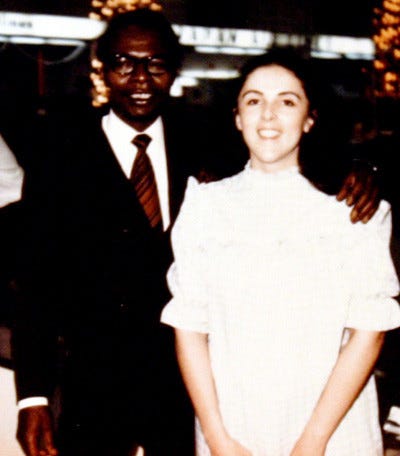
Obama Senior and Ann Dunham
The two were married in February 1961, despite the fact that Obama Senior already had a wife and two children in Kenya, polygamy being commonplace there at the time. President Obama was born six months later.
The marriage did not last, and the couple divorced in 1964. Obama Senior returned to Kenya and rose to become a senior government economist. But his standing was fragile: his public criticism of the government’s economic direction had made him enemies, and in 1969 his mentor Tom Mboya, widely seen as a future president, was assassinated by a “lone gunman”. Without Mboya’s sponsorship, Obama Senior fell out of favour. He sank into alcoholism and poverty, and died in 1982 in the last of a series of serious car crashes.
Lolo Soetoro
The same Cold War system brought Ann Dunham her second husband. Lolo Soetoro came to the EWC from Indonesia in 1962, sent by the Army Topographic Service, where he had long worked as a civilian.
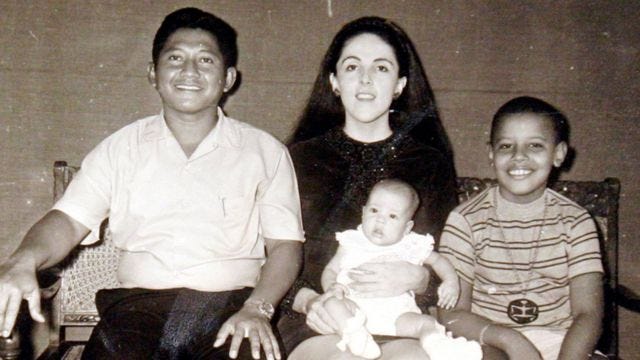
Lolo Soetoro, his wife Ann Dunham, daughter Maya Soetoro and stepson Barack Obama.
Soetoro and Dunham were married in Hawaii, by most accounts in March 1965. Soon after in October, Indonesia was convulsed with political violence and unrest, in response to a coup attempt, Major General Suharto, who would become Indonesia’s next president, seized control of the Army and began a purge of suspected communists that would leave an estimated 500,000 to one million dead — events known as the Indonesian mass killings of 1965-66.
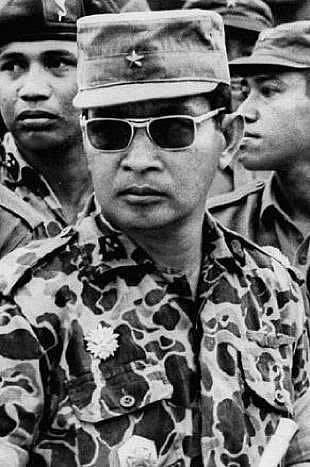
Suharto in 1967
The worst of Indonesia’s carnage was subsiding, as Soetoro, now Barack Obama’s stepfather, left the EWC and returned to Indonesia to serve in Suharto’s army. Ann Dunham followed him there with six-year-old Barack in October 1967.
Suharto had become president with American help: the CIA and the US government had been actively involved in bringing down his predecessor, Sukarno, and in supporting the forces that replaced him.
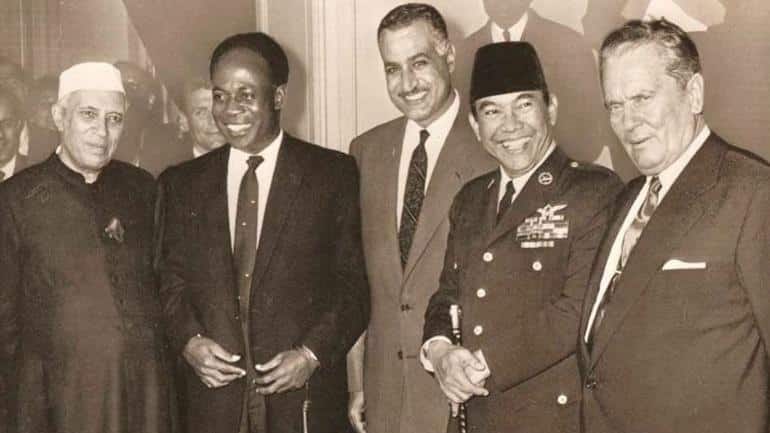
Nehru, Nkrumah, Nasser, Sukarno and Tito in New York in 1955
Sukarno had been an enthusiastic champion of the non-aligned movement. Alongside other leaders such as Nehru, Nkrumah, Nasser and and Tito his goal had been to avoid taking sides in the Cold War and to maintain independence. Suharto, by contrast, would prove compliant with US wishes.
Suharto was not widely known as a mass murderer before 1965, but by the time he was installed as Indonesia’s ruler in 1966–67, the massacres that established his power were already underway or complete. Western governments knew that his ascent had been accompanied by extraordinary violence. At the time, local beliefs held that mutilation of the body would mutilate the soul and was routinely performed by the perpetrators.[3]
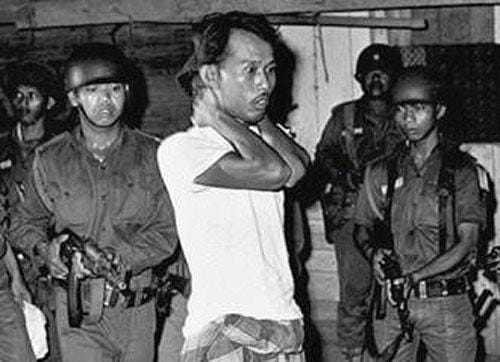
An alleged PKI member after his arrest by Indonesian security forces, October 1965.
The term “mass killings”, would be seen by many as a euphemism for “genocide.”[4] People were slaughtered for being suspected “communists.” Many of them, however, were illiterate farmers with little grasp of politics.
Outrageously, American officials helped. Embassy staff compiled lists of suspected communists and handed them to the Indonesian army, knowing what would follow. “It really was a big help to the army,” one embassy political officer told the Washington Post years later. “They probably killed a lot of people, and I probably have a lot of blood on my hands.”[5]
In his memoir Obama writes: “In later years my mother would insist that had she known what had transpired in the preceding months, we never would have made the trip. But she didn’t know the full story of the coup.” [6] The killing had subsided by the time of Dunham’s arrival, but more than a million people were still imprisoned without trial. Repression under Suharto would continue for decades.
In the same passage Obama writes: “My stepfather, who had seen his student visa revoked while still in Hawaii and had been conscripted into the Indonesian army a few months before our arrival, refused to talk politics with my mother, advising her that some things were best forgotten.”[6] “Conscripted” is an odd word for a man who had long worked for the Army Topographic Service, the body that sent him to Hawaii in the first place.
Elsewhere in his memoir, Obama describes his stepfather as often being found “wandering through the house with a bottle of imported whiskey, nursing his secrets.” The image conjured is of a placid drunk swept up in events beyond his control.
Ann Dunham
So apart from being Obama’s mother, who was Ann Dunham? Her Wikipedia entry introduces her as an anthropologist with an interest in cottage industries and microfinance. It feels immensely worthy: how better to help the poor in developing countries? But something is being left out.
Dunham arrived in Jakarta in 1967, in the aftermath of the mass killing but during ongoing repression. She went on to spend the best part of the next three decades travelling Indonesia as an anthropologist, and she stayed until her death, fifteen years after divorcing Soetoro in 1980. The massacres had been reported in the Western press and were not a secret. What the wife of an Indonesian army officer knew, or chose not to ask, is not documented.
Diversity of political opinion was not tolerated during the Suharto era, which covers all of Ann Dunham’s time in Indonesia. The regime’s violence was not a one-off but a recurring feature, running from the anti-communist massacres of 1965–66 until the end of the Suharto era. The following are some of the main atrocities (estimated numbers of fatalities in brackets):
1975–1999 Invasion and occupation of East Timor — (100,000+, most from famine and disease, 10,000+ in war crimes)
1976 Southern Jayapura bombings (Papua) — (~1,600)
1977–1978 Baliem Valley campaign (Papua) — (4,000–26,000+)
1982–1985 Petrus killings — (hundreds to several thousand)
1983 Kraras massacre — (~200–300)
1984 Tanjung Priok massacre — (dozens to hundreds)
1989 Talangsari massacre — (dozens to ~130)
1989–1998 Aceh DOM operations — (9,000–12,000)
1991 Santa Cruz massacre — (~250)
1998 May 1998 riots — (~1,000–1,500)
Ann Dunham’s funders
Much of Dunham’s work in Indonesia was supported by the Ford Foundation, USAID and the World Bank, all institutions with explicit strategic roles in Cold War Asia.[7]
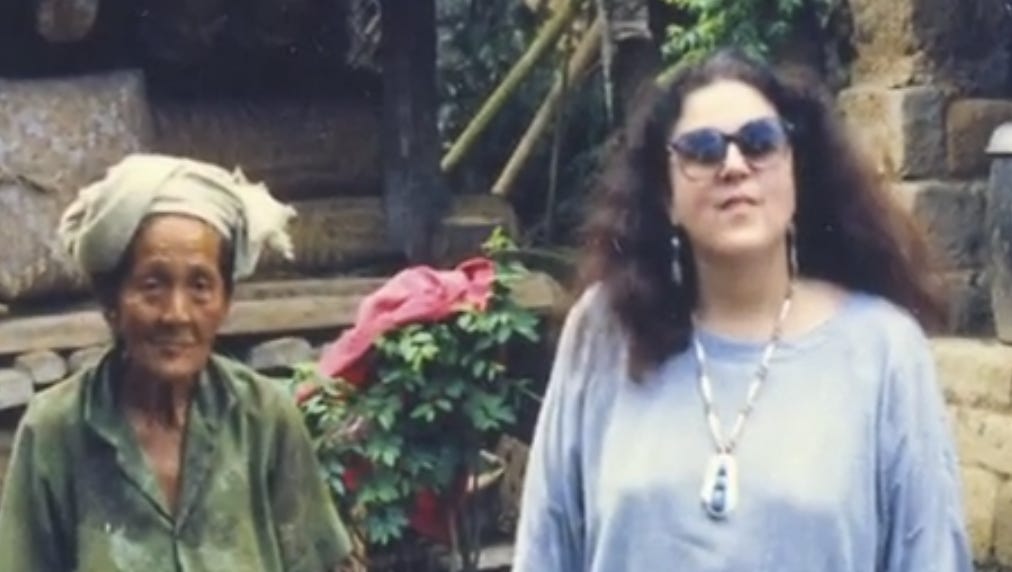
Ann Dunham with unknown Indonesian woman
Consider the Ford Foundation. In 1970, David Ransom wrote in Ramparts Magazine that Ford-funded academics, the so-called “Berkeley Mafia”, helped shape Indonesia’s new order after 1965. In its 2003 history, Celebrating Indonesia, Ford summarised his article like this:
“He described Indonesia’s political upheaval of 1965 and 1966 as being the product of a sinister and elaborate American plot. The culprits? Ford Foundation, Rand Corporation, USAID, the Council on Foreign Relations, assorted American universities, and the CIA.”[9]
That is not what Ransom wrote. He was explicit that the new order was “not imposed by American troops”, that the CIA and the Pentagon played “no more than a subordinate role”, and that it was “the hallowed private institutions of academia and philanthropy that worked the greatest wonders.”[8] Ford answered a caricature, dismissing it as “fodder for conspiracy theorists”, while conceding in the same document that it had enormous influence on Indonesia’s destiny in those years.[9] A private foundation, by its own account, had enormous influence on the country as it veered into catastrophe.
Separately, numerous others have argued that the Ford Foundation served as a conduit for CIA money - a different claim from Ransoms.[10][11][12]
Here is what is remarkable. Ann Dunham, like many foreigners of the time, could live and work in Jakarta in safety, while elsewhere in the country people were being bombed, starved and massacred. The violence was regional and selective. It stayed largely out of sight of those it did not target, especially if they looked the other way.
I know of no evidence that Ann Dunham knew of, or deliberately assisted, her funders’ Cold War aims to dominate and control, or that the information she gathered was used for anything beyond its stated academic purposes. However, diplomats, academics, foundation staff and the families of officers were living well, inside a system that was killing people, and too many of them chose not to look. A system on this scale needs people who look away, and those who benefit from it and stay silent are part of how it runs.
In Conclusion
What is lost when the Cold War is left out of Obama’s story is at least half of the story. The opportunities in his family history were real, and so was the ruthless machine that produced them.
We were led to see Barack Obama’s rise to the White House as a spectacular version of the American rags-to-riches Dream. Notice the romance Obama himself injected into the story, in his 2008 campaign speech “Reclaiming the American Dream”:
“I am standing here today because that dream was realized — because my grandfather got the chance to go to school on the GI Bill, buy a house through the Federal Housing Authority, and move his family west — all the way to Hawaii — where my mother would go to college and one day fall in love with a young student from Kenya. I think back to the chances that somebody, somewhere gave my family. The ticket my father got to come study in America. The opportunity my mother had to put herself through graduate school.”[13]
Obama’s pitch was for the American Dream, but the “somebody, somewhere” who gave his family chances, is doing a lot of work. The ticket his father got was part of a contest between states for the allegiance of newly independent nations, and the same state, and many of the same institutions, were backing a regime that killed hundreds of thousands or possibly more.
Obama’s speech idealises the chances and opportunities that he and his family benefited from. But here, as is the case too often, the American Dream is a story told with parts left out. The shop window advertised freedom, democracy and opportunities for the little guy. Out back, there was blood all over the floor; in Indonesia, it was ankle deep.
See also:
and
Notes
[1] Edward Teller quoted by Walter B. Wriston in “Technology and Sovereignty,” Foreign Affairs, Winter 1988. https://www.foreignaffairs.com/articles/1988-12-01/technology-and-sovereignty
[2] “East–West Center,” Wikipedia. https://en.wikipedia.org/wiki/East%E2%80%93West_Center
[3] Holocaust Museum Houston: Indonesia, 1965-1966. https://hmh.org/education/indonesia-1965-1966/
[4] International People’s Tribunal 1965, The Hague (2016). Chief Judge Zak Yacoob (former South African Constitutional Court justice) found Indonesia guilty of crimes against humanity and that the killings fell within the Genocide Convention, plus complicity by the US, UK and Australia. https://www.tribunal1965.org/
[5] Kathy Kadane, “U.S. Officials’ Lists Aided Indonesian Bloodbath in ‘60s,” The Washington Post, 21 May 1990. https://www.washingtonpost.com/archive/politics/1990/05/21/us-officials-lists-aided-indonesian-bloodbath-in-60s/ff6d37c3-8eed-486f-908c-3eeafc19aab2/
See also US Department of State Airgram A-398, 17 December 1965, National Security Archive. https://nsarchive.gwu.edu/document/15719-document-23-us-department-state-airgram-398
[6] Barack Obama, Dreams from My Father: A Story of Race and Inheritance (1995).
[7] USAID History. https://www.developmentaid.org/api/frontend/cms/file/2022/11/Pnacy535.pdf
[8] David Ransom, “The Berkeley Mafia and the Indonesian Massacre,” Ramparts, Vol. 9, No. 4, October 1970. https://la.utexas.edu/users/hcleaver/357L/357LRansomBerkeleyMafiaTable.pdf
[9] Ford Foundation, Celebrating Indonesia: Fifty Years with the Ford Foundation, 1953–2003 (2003). https://www.fordfoundation.org/wp-content/uploads/2015/03/2003-celebrating_indonesia.pdf
[10] “The CIA and the Intellectuals,” The New York Review of Books, 20 April 1967. https://www.nybooks.com/articles/1967/04/20/the-cia-and-the-intellectuals/
[11] “Who Paid the Piper?” Wikipedia. https://en.wikipedia.org/wiki/Who_Paid_the_Piper
[12] “Ford Foundation,” Transatlantic Perspectives. https://www.transatlanticperspectives.org/entries/ford-foundation/
[13] “Remarks in El Dorado, Kansas: ‘Reclaiming the American Dream’,” 29 January 2008. https://www.presidency.ucsb.edu/documents/remarks-el-dorado-kansas-reclaiming-the-american-dream
Both, I guess? "American Dream" AND cold war product? Her father going to college and buying a home on the GI bill. The Berkeley influence in those times. People deluding themselves thinking they were "helpers." History unfolds, and we're left to put the pieces together in some semblance so there's narrative. In my elder hood, I find it's often, yes; And. Lessons to be learned. Too often, it seems, empire, imperialism and hegemony are the corrupt forces deceiving us at every turn. I've become quite the hopeful skeptic, if there's such a thing.