

Dag Hammarskjöld believed that the United Nations could do something rare in modern politics: stand above power rather than among its lackeys. In 1961 he flew into the Congo as UN Secretary-General with a faith in his office that was noble, but possibly also fatal.
One event can be explained away. A sequence becomes harder to dismiss. When repeated sequences form a pattern, doubt begins to look less like healthy scepticism and more like cowardice. A hypothesis that identifies and explains the pattern is hinted at in the following table:
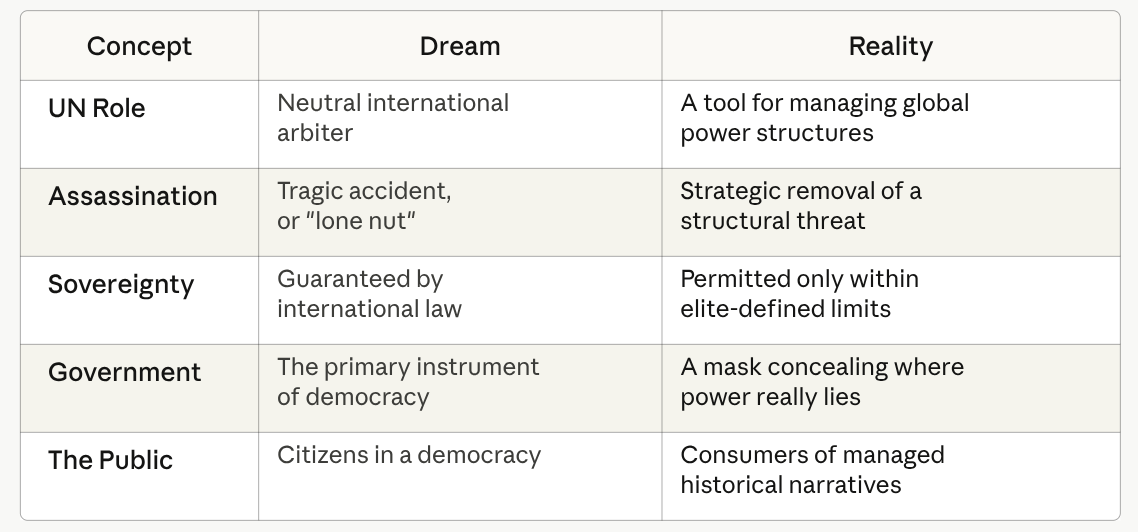
In some important respects, the world is not governed as we are told it is. Neutral does not always mean neutral. Accidents, it seems, are sometimes done accidentally on purpose. The public is encouraged to think in fragments that, in isolation, mean little.
Control by Excision
US regime-change operations are usually discussed one episode at a time, as if each belonged to a sealed moral universe. Iran. Guatemala. Congo. Chile. Vietnam. Indonesia. Each treated as a discrete controversy — regrettable, but isolated.
Stack them, and the picture changes. Not unfortunate misunderstandings and random bad actors, but a recurring logic: when a leader moves from rhetoric to action, the system responds.
Mosaddegh challenged foreign control of Iran’s oil. Árbenz threatened the landholding power of an American corporation. Sukarno articulated a vision of non-alignment that was intolerable to hegemonic powers. Allende pursued economic sovereignty and ran headlong into interests that had no intention of allowing it.
Different countries and different pretexts, but the same underlying offence: acting as though sovereignty meant something.
The response is not always a coup or a bullet. Sometimes it is sanctions, propaganda, colourless diplomatic language, the patient erosion of legitimacy. But the aim is the same: to remove, neutralise, or discipline those who challenge the operating assumptions of power.
Who is behind such acts? Not necessarily a smoky room of sinister men sipping their whisky while conferring on the deeds of the day. Reality is less theatrical and more durable: an interlocking ecosystem of corporations, banks, dynastic wealth, intelligence agencies, bureaucracies and diplomatic networks. Importantly there are people who move between these worlds without ever having to explain themselves to voters.
The Congo Test
The Congo is where Hammarskjöld enters — not as a side note, but as a revelation. He believed the United Nations could be something more than a stage set. He thought that international law could restrain the older pathological habits of empire. The Congo tested that belief to destruction.
The Congo was not merely a post-colonial crisis. It was a test of whether independence would mean anything beyond a formality. The overt architecture of empire was collapsing, but the old habits and expectations remained intact. The valuable minerals were still there. The strategic anxieties remained as did the fear of African independence becoming more than symbolic. Under Hammarskjöld, the UN began to look less like a ceremonial forum and more like an instrument that might actually be used — one that could give real meaning to the independence that new African states had formally acquired, rather than merely supervising a change in terminology.
Hammarskjöld knew the odds. He was not naive about the power games being played by both sides in the Cold War. He understood that neither Washington nor Moscow wanted a truly independent Congo. He knew that that both sides could be ruthless. He insisted on an independent UN regardless. That insistence was, in the end, the point.
The Crash and the Question
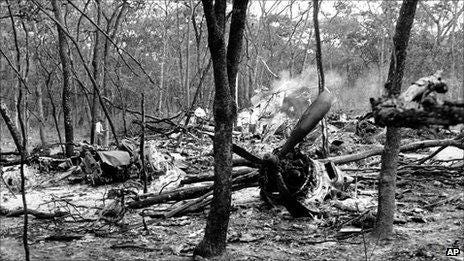
On 17 September 1961, his plane came down near Ndola, in what was then Northern Rhodesia. Hammarskjöld and fifteen others were killed. Officially, it was a tragic accident.
The questions began almost immediately and have not stopped since. Local witnesses reported seeing a second aircraft in the vicinity. Others reported hearing shots. Communication records were incomplete, delayed, or missing. Subsequent investigations — including a 2017 independent panel commissioned by the UN — concluded that the evidence was consistent with an external attack or sabotage, and called for further inquiry. No definitive answer has ever been established. The key files in multiple jurisdictions, remain classified, if they have not been lost. [1]
Individual anomalies can always be disregarded as unexplained mysteries. But when they accumulate — the witness accounts, the missing records, the delayed reports, the redactions, the institutional incuriosity — the balance of probabilities shifts. A singular argument can be brushed aside as a one-off. A cumulative argument becomes too strong to be ignored. This is true whether we consider details of this particular plane crash, or the rise of US hegemonic power at the end of the twentieth century.
Parameterised Freedom
What happened at Ndola, whatever its cause, illustrates the process. Modern liberal power does not present itself as tyranny. It invites the public to believe in impartial institutions, sovereign nations bound by constitutions, and curated versions of history.
Independence is tolerated only as long as it remains decorative. Reform may be allowed unless it is structural.
Hammarskjöld believed that principle, exercised through international institutions, could triumph over force. In the Congo, he found the limit of that belief — a ruthless and implacable opposition that did not argue back, but took silent action.
His death matters, not only as a personal tragedy, but for the pattern it reveals alongside the stories of others: Mosaddegh, Árbenz, Sukarno, Allende and more. Each case has its own character and uncertainties, but taken together, there is a pattern and shape that cannot be dismissed as coincidence.
The fragmentation of history serves power well. If every story is isolated, every outrage can be treated as an exception. The larger structure stays invisible and the public can be reassured that troubling incidents are merely a series of unfortunate, but meaningless local events.
But once the episodes are stacked, what becomes visible is a world system whose real priorities are not self-determination but control. Not justice, but continuity. Not truth, but deniability.
The public clings to the accident narrative because it is psychologically cheaper. It is easier to treat the worst events in modern history as anomalies than to accept that they are features, not bugs of the system we are part of.
If Hammarskjöld was killed, his death was a demonstration of how power protects itself. If it was truly an accident, the wider argument still stands. No single hand needs to have directed events. The world he inhabited had perfected something durable but well camouflaged: a system in which corporations, states, intelligence agencies and financial elites had enough in common that coordination was rarely necessary.
Democracy provides the scenery. The casting decisions are made offstage. That is the operating system. And once seen, it cannot be unseen.
[1] Susan Williams’ Who Killed Hammarskjöld? (2011) remains the most thorough examination of the Ndola evidence.