

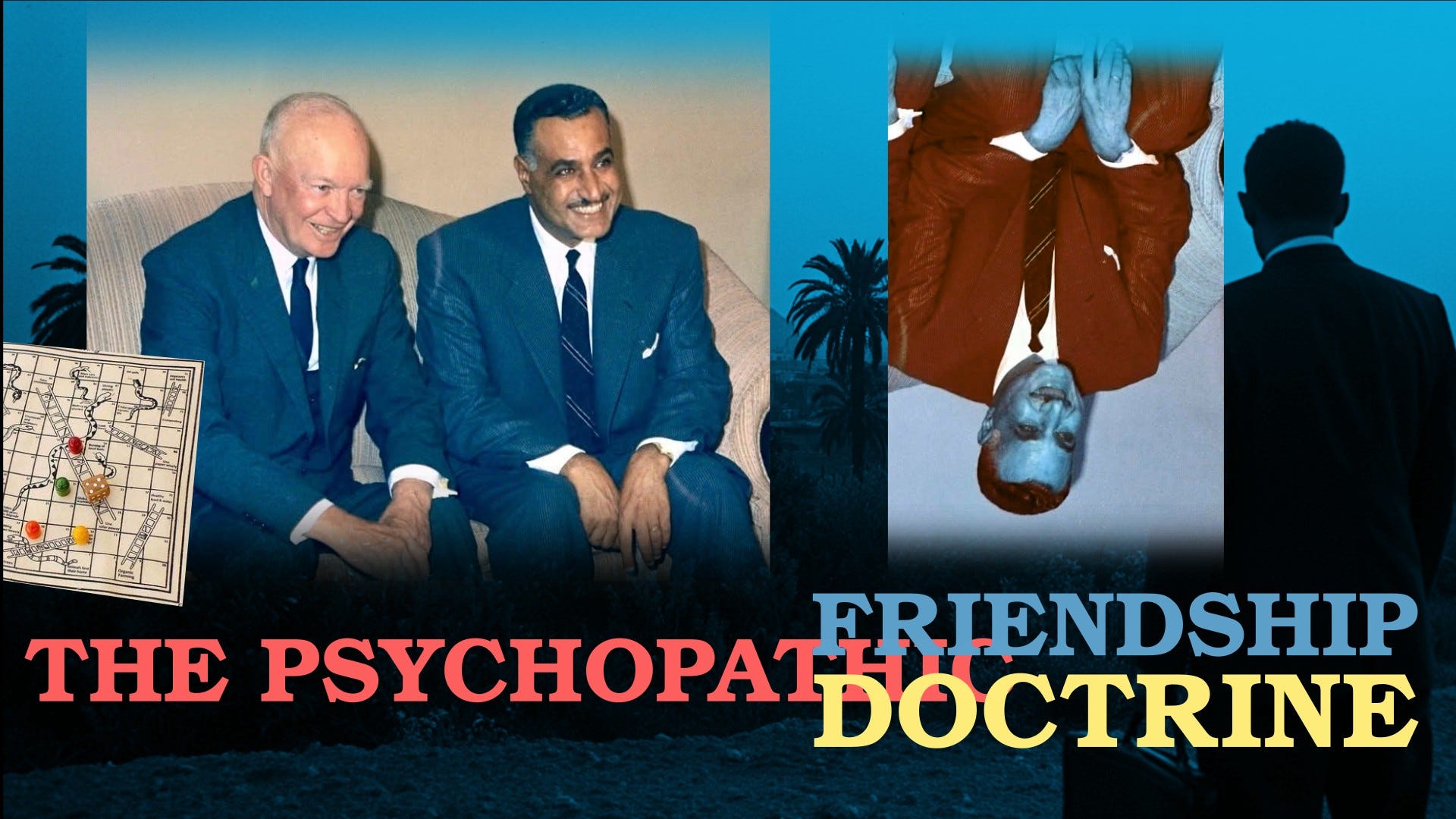
Imagine a neighbour who frequently borrows your ladder. One day you need it yourself. He smiles, thanks you, and borrows a ladder from someone else. The next morning, because you are no longer useful to him, he burns your house down while you sleep.
When an individual does something like this, we term it psychopathic, the absence of moral compass. But for a superpower, we call it foreign policy.
Nasser — America’s late night drinking buddy.
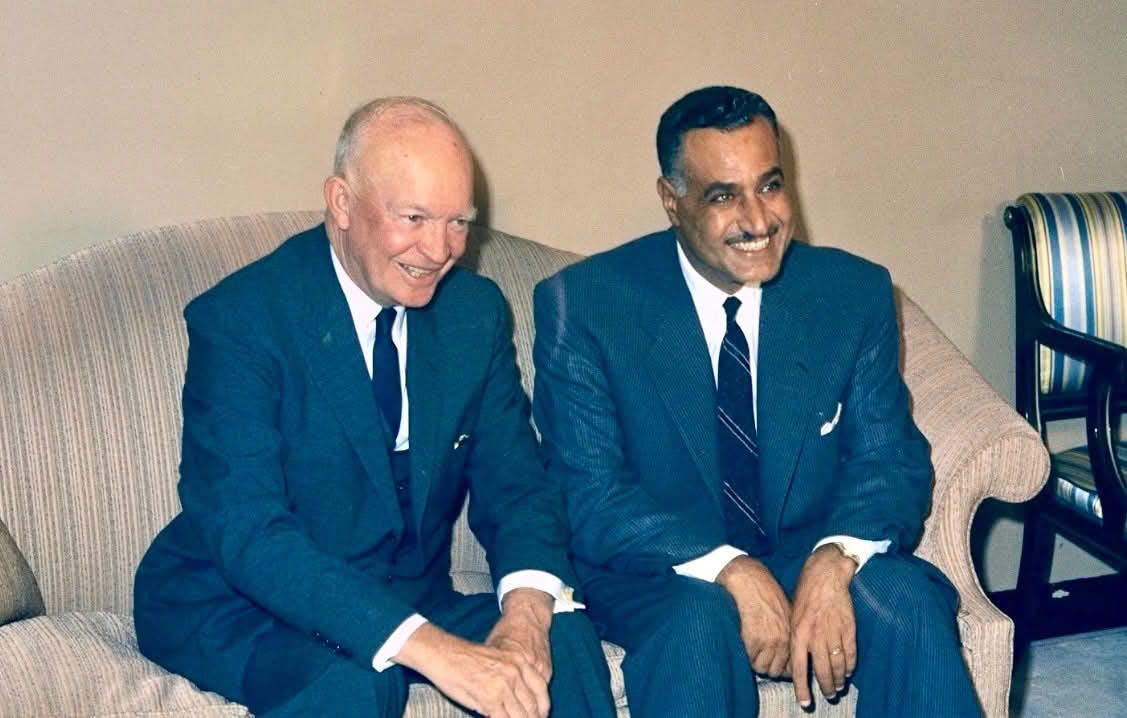
In 1952, Egypt’s British-backed monarchy was overthrown. The US was eager to gain influence and sent CIA Agent Kermit Roosevelt to befriend President Nasser. reportedly “thrilled with each other”.
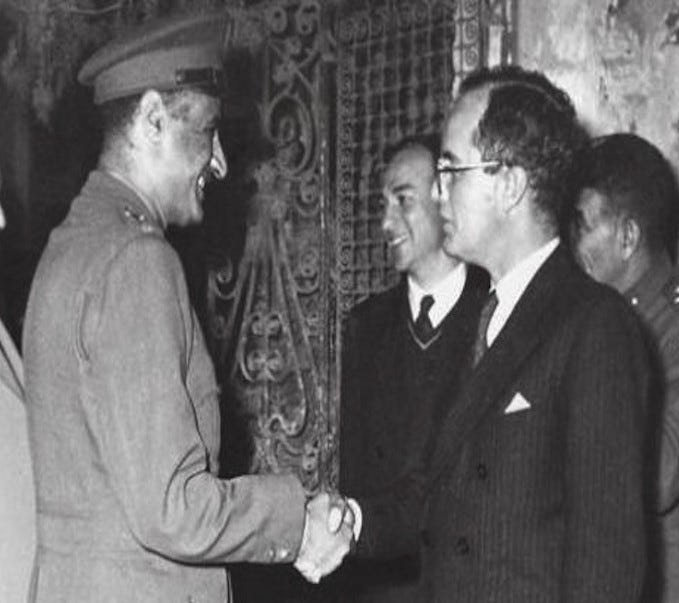
Miles Copeland, the CIA’s Cairo station chief (and father of Stewart Copeland, drummer of The Police), regularly stayed up late drinking and joking with the Egyptian leader. Washington thought things were under control
But Nasser was a proud Egyptian who believed in genuine independence. He co-founded the Non-Aligned Movement, seeking not to take sides in the cold war. He nationalised the Suez Canal to the fury of the British and French. When Washington refused to help fund the Aswan dam, he turned to Moscow. This may have been the last straw. The friendly Western faces stayed in place, but behind them, assassination plots began. One such plan came to light when the £20,000 sent by MI6 was delivered to the wrong person. The money was intended for Nasser’s doctor, an inducement to administer a lethal injection.
In 1970, aged 52, Nasser died, officially, of natural causes, a heart attack. The timing was perfect for his enemies and within years, his successor, Anwar Sadat, had reversed every policy and realigned Egypt with Washington.
The pattern is this: befriend a useful leader, borrow his ladder, extract what you need, but when he fails to do as you wish — keep smiling, but burn his house down.
Nasser of course was not the only one.

The Precedent — Mossadegh

Two years before the CIA met Nasser, the same Kermit Roosevelt had overthrown the government of Mohammad Mossadegh in Iran.
Mossadegh had been educated in Switzerland and was a democrat by instinct. He had appealed to Washington in 1951 as a natural ally — a man who believed the United States, having fought its own anti-colonial war against the British, would understand Iran’s wish to control its own destiny, also in defiance of the British. He made his case in Washington but Truman listened and sent him home empty-handed.
Soon after, the British lost their oil to Iran’s nationalisation program and Mossadegh refused to back down. In 1953, the CIA and MI6 spread propaganda and bribed politicians and rioters. Mossadegh was deposed, arrested and tried by prosecutors seeking death by hanging. In the end his sentence for supposedly trying to overthrow the monarchy, was reduced to three years solitary confinement, followed by house arrest for life.
So although Mossadegh was aligned with Western values, the moment he stepped out of line, the West installed the Shah, ending Iran’s democracy and Mossadegh’s freedom.
The Catholic Nationalist — Diem

South Vietnam’s Ngo Dinh Diem was America’s man in Saigon. Washington put him in place, funded him, and backed him as president of a shaky anti-communist state. For nearly a decade, he was useful even if his government was authoritarian and repressive towards the country’s Buddhist majority.
Then a 73-year-old monk named Thich Quang Duc sat down at a busy Saigon intersection and set himself on fire in protest. The pictures circled the globe. America was embarrassed. But even worse, Diem had begun privately exploring peace options with Ho Chi Minh’s North Vietnam.
In November 1963, the CIA backed a coup. Diem and his brother were murdered in the back of an armoured personnel carrier. President Kennedy was shaken. He knew what the American machine had done and that he had been unable to stop it.
Three weeks later, JFK too was dead. Diem had been useful. Then he wasn’t. Borrow the ladder. Burn the house.
The Payroll Dictator — Noriega

Manuel Noriega is remembered as a drug trafficker, arms dealer, and brutal dictator of Panama. In 1989, the US invaded, arrested him, and he died in prison. Good riddance, most people might say.
They should know the rest. Before 1989, Noriega was on the CIA payroll — paid $100,000–200,000 per year for intelligence on Cuba and Nicaragua. Washington knew exactly how he operated.
The problem was not his murderous brutality, that was accepted and paid for. The problem was that he started to embarrass his masters. In 1988 a US grand jury indicted him for drug trafficking, and Noriega refused to go quietly. So the US invaded, bombed civilians in Panama City, and dragged Noriega to Miami in chains.
Noriega’s character had not changed, only his usefulness. Borrow the ladder. Burn the house.
The Handshake — Saddam

In 1990 Saddam Hussein invaded Kuwait. Two wars followed, led by two presidents named Bush. Saddam ended his days hanged by the neck, his execution filmed on a mobile phone while his captors shouted insults. Few tears were shed for him in the West.
But before he was enemy number one, he was a friend worth cultivating. In 1983 Donald Rumsfeld, then Ronald Reagan’s special envoy, flew to Baghdad for a friendly visit. The US was providing satellite intelligence and dual-use chemicals to Iraq during its war with Iran — well aware that those chemicals would be used against Kurds. When Halabja was gassed in 1988, the US deceitfully blamed Iran.
When Saddam invaded Kuwait in 1990, the US ambassador had reportedly signalled ambiguity about Iraq’s border disputes. Saddam must have been shocked the next day to be declared the new Hitler.
His crimes had not changed, only his usefulness. The US no longer needed his ladder, so they burned his house down.
The Longest Burn — Afghanistan
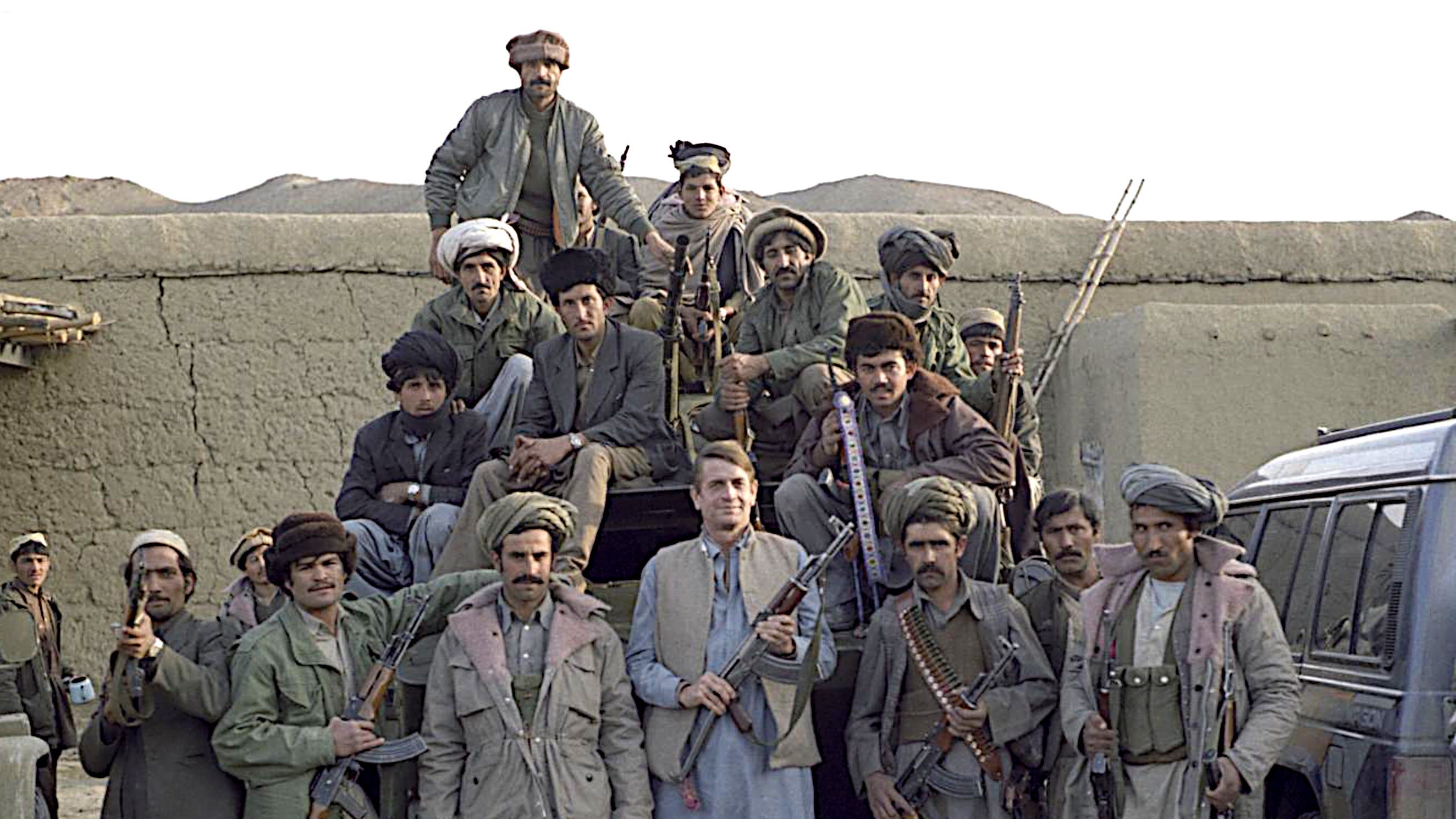
During the 1980s, the CIA ran Operation Cyclone — the largest covert operation in its history. Billions of dollars in weapons were funnelled to Islamic fighters resisting Soviet occupation. The effort was championed by Texas Congressman Charles Wilson, leaning into the principle that the enemy of my enemy is my friend.
When the Soviets withdrew in 1989, Washington walked away. Afghanistan collapsed into civil war and the Taliban emerged. The weapons the CIA had supplied now served new masters — people who described America as the Great Satan.

After the attacks of September 11 2001, America invaded — to “fight terrorism”. For twenty years it fought a war against people they had once armed until withdrawing abruptly in 2021. The US left behind an estimated $7 billion in military equipment. Unsurprisingly most of this was gratefully received by the same Taliban.
Arm them, fight them, arm them again, run. Borrow the ladder, burn the house, borrow again, burn again. Rinse and repeat. Nothing achieved, except death, destruction and enormous profits for the arms industry.
The Drainage Pipe — Gaddafi
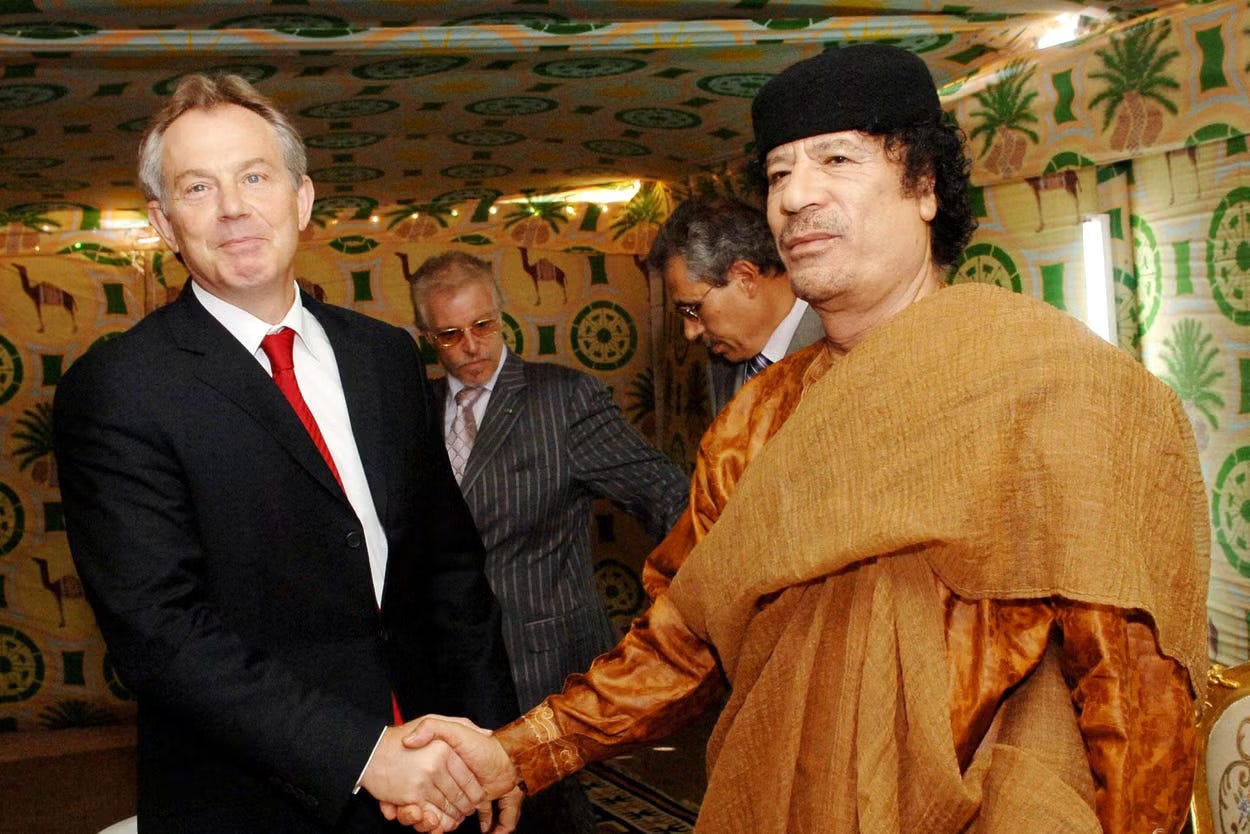
Muammar Gaddafi seized power in a 1969 coup, overthrowing a Western-backed monarchy. In the West he was considered a sponsor of terrorism. But inside Libya, he was popular, using oil wealth to make the country into Africa’s richest. Libyans had free healthcare, free education, free electricity, and interest-free loans. The literacy rate rose from 10% to over 90%. His people had never had it so good.
In 2003 he voluntarily cancelled a nascent nuclear weapons programme and in return, the West embraced him. Tony Blair paid a friendly visit to his tent. Western investment poured in. The ladder was now firmly in place.
Then Gaddafi began to talk about a gold dinar — an African currency that would allow Libya and its neighbours to sell oil outside the petrodollar system. This was like taking the bottle from a drunk. Shortly afterwards, NATO bombed Libya into chaos. Gaddafi was captured hiding in a drainage pipe and killed by a mob. The “rehabilitation” was complete. Now high living standards and social welfare in Libya have been replaced by open air slave markets.
From Blair’s tent to a drainage pipe in eight years. Borrow the ladder. Burn the house.
The Burning Ladder — Yanukovych

Viktor Yanukovych was a corrupt and authoritarian leader of Ukraine — the West knew this. He was also useful as a lever to try and pull Ukraine away from Russia, so the EU courted him. But the courtship was miserly: €610 million against the $160 billion he said he would need to cover the loss of Russian trade. Also the West insisted on some harsh conditions. The IMF demanded brutal austerity and the EU insisted he release his political rival Yulia Tymoshenko from prison. The deal was friendship in return for political suicide.
In November 2013, Yanukovych said no to the EU and accepted $15 billion from Russia instead as well as a crucial one third discount on energy prices.
On 20 February 2014, violence erupted in Kiev’s main square, the Maidan. Snipers - no one knows whose - killed dozens of protesters and the ensuing chaos and retribution broke Yanukovych. EU foreign ministers brokered a deal — reduced powers for the President, a unity government and early elections. Yanukovych signed, but within 24 hours the deal was shattered by violent right-wing agitators. The deal’s EU “guarantors” said nothing.
Weeks earlier, a leaked phone call had caught Victoria Nuland, Obama’s top diplomat for Europe, picking the next prime minister: “Yats is the guy.” The EU had other ideas, but as Nuland said in that infamous call: “F**k the EU.
Yanukovych was forced to flee to Russia in a helicopter. From the West’s point of view, he should have signed the EU’s deal. When he didn’t the housed started to burn.
And Inline with Nuland’s “recommendation” Arseniy “Yats” Yatsenyuk did indeed become the next prime minister of Ukraine.
But the house continued to burn, especially in Eastern Ukraine where pro-Russian and pro-Western factions fought a civil war. Rather than send the fire-brigade, the West sent truckloads of bombs and explosives. They blamed Russia, deceitfully characterising events as an “unprovoked invasion”. They hoped the fire would damage Russia.
As Ukraine was consumed by the fire, the West insisted on calling itself the country’s best friend.
Conclusion
A person who burns your house when you no longer have a ladder to lend them we would call a psychopath. What about a country or a system of countries?
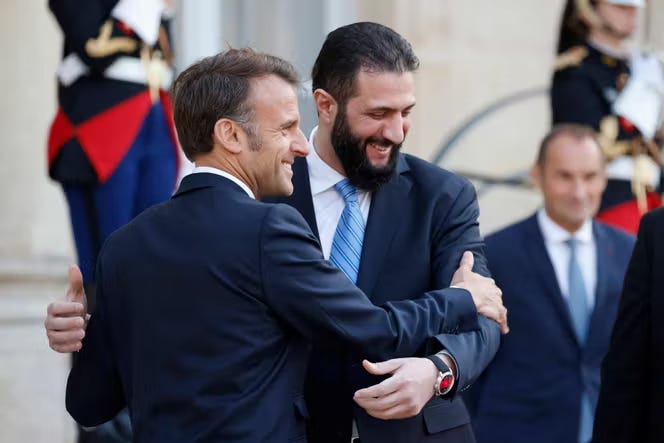
Sometimes the doctrine runs in reverse. Enemies stop being enemies the moment they become useful. Ask the new man in Damascus.
See also: