

In 1954 the CIA didn’t just topple the government in Guatemala; it tested its own god complex.
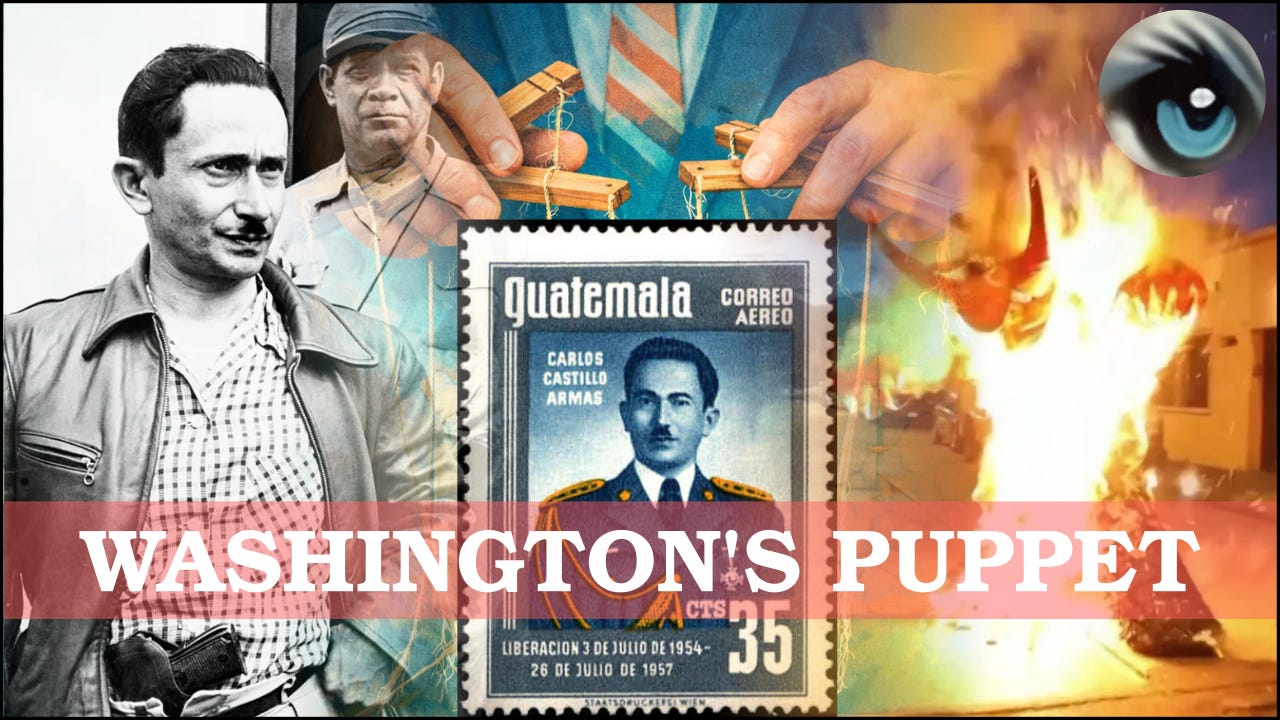
Colonel Carlos Castillo Armas, exiled for his extremism, was pushed forward to rule the country as Washington’s chosen dictator: obedient and loudly “anti‑communist.”
Installed through the CIA’s Operation PBSuccess, he was selected for pliability rather than ability. He depended on U.S. advisers whispering policy into his ears and American dollars to keep an illusion afloat that he was anything but a disaster.
Even the CIA saw the cracks — a paranoid man with no charisma, lost without orders. Yet a myth was created: Guatemala “liberated,” democracy “restored.”
The story of Castillo Armas is as much about the West’s ability to deceive itself as it is about Guatemala’s unravelling.
The Architect’s Delusion
Overthrowing Árbenz had been almost embarrassingly easy and Washington drew the wrong lesson. If the Guatemalan people could be programmed into accepting an externally selected dictator perhaps they could also be controlled long-term?
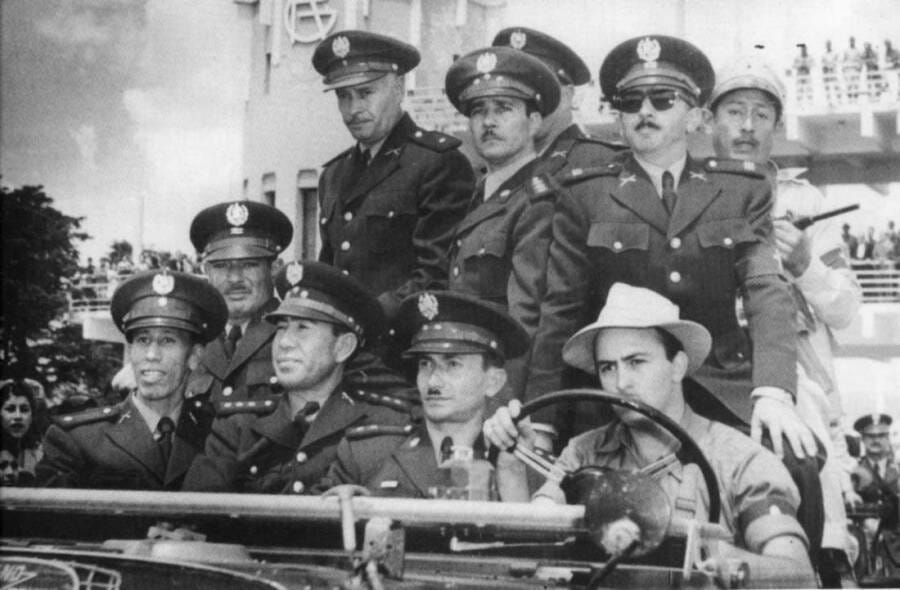
So it was with full U.S. support that Castillo Armas assumed power — winning an election in which he was the only candidate and all political parties were banned.
Castillo Armas’s rule began with the arrest of thousands of opposition leaders, branded “communist” and placed in specially built detention centres. He acted in line with U.S. priorities, reversing the land reforms of his predecessor so that the American United Fruit Company regained control of the bananas — much to the satisfaction of the Dulles Brothers — men who knew United Fruit rather well. This was a blow to rural Guatemalans, but changes to electoral rules meant they were silenced. Peasants who refused to leave the land when told were simply arrested. At the same time, lists were compiled of suspected communists, leading to further arrests, dismissals, and a climate of fear. The U.S. provided the regime with financial assistance, advice, and guidance.
But people are not programmable. The policies imposed by Washington via Castillo Armas did not settle Guatemala; they fractured it. Legitimacy was manufactured, dissent suppressed, and stability continually propped up from abroad.
When Control Becomes Chaos
Washington’s assumption that they could control Guatemala collapsed on contact with reality. The officers and mercenaries who had helped put Castillo Armas in power proved unequal to the task of running a country — and thoroughly corrupt. As Castillo Armas silenced the press and crushed unions, the economy showed little sign of stabilising, despite the incoming flow of dollars.
It was a regime built on fear and fantasy, and it began to devour itself. Every purge, every “communist plot,” every midnight arrest revealed a government terrified of its own shadow.
The Puppet String Snaps
In July 1957, Castillo Armas was shot dead by one of his own guards. A regime built on paranoia had finally turned the gun inward. It wasn’t so much an assassination as an implosion — the system had lost its ability to distinguish friend from foe.
He was followed by successive iterations of non-democratic rule, while the disenfranchised rural population became more organised and violent in its resistance. The consequence was thirty-six years of civil war. Between 1960 and 1996, the country saw massacres, disappearances, and a genocidal campaign against indigenous Mayan communities. More than 200,000 civilians were killed.
In 1999, the Guatemalan Commission for Historical Clarification found that ninety-three percent of the atrocities were committed by Guatemala’s U.S.-backed military. These murderous decades were the long echo of 1954 — fear turned into a system.
The Illusion of Control
Castillo Armas’s brief rule exposed Washington’s delusion — the belief that artifical controls, once installed, could endure. America’s chosen dictator died in his palace, shot by one of his own men. Yet the paranoid arrogance that created him persisted — assimilated and lurking within the operating model of the West.
The empire’s enemy was never really communism. It was reality itself.
5 minute film telling the story of the Guatemalan coup of 1954: