

The West tells the Taiwan story as if it were settled: a democracy, threatened by an autocratic neighbour. That simplicity is more a misdirection than a statement of fact. Nearly every government and official body operates on the opposite premise: Taiwan is part of China.
The purpose of this article is not to argue the case — it is to show both sides of the argument. The imbalance is impossible to ignore once you see who sits in which camp.
NO — Taiwan is not part of China
Taiwan’s Democratic Progressive Party and the Taiwan independence camp say Taiwan is a sovereign, independent country.
Western media frames Taiwan as a separate country under threat from its neighbour. This does not reflect any official position, but it shapes public opinion more than any official statements might.
Governments that recognise Taiwan as an independent state: Belize, Guatemala, Haiti, Paraguay, Saint Kitts and Nevis, Saint Lucia, Saint Vincent and the Grenadines, Tuvalu, Eswatini, the Marshall Islands, Palau, and the Holy See and no other countries
YES — Taiwan is part of China
The People’s Republic of China (Chinese Communist Party, Beijing) The One-China principle: Taiwan is an inalienable part of China and unification is a national task.
The Republic of China (Kuomintang, Taipei). Its own constitution still claims jurisdiction over all China, including the mainland. The government the United States armed for decades says Taiwan and China are one nation.
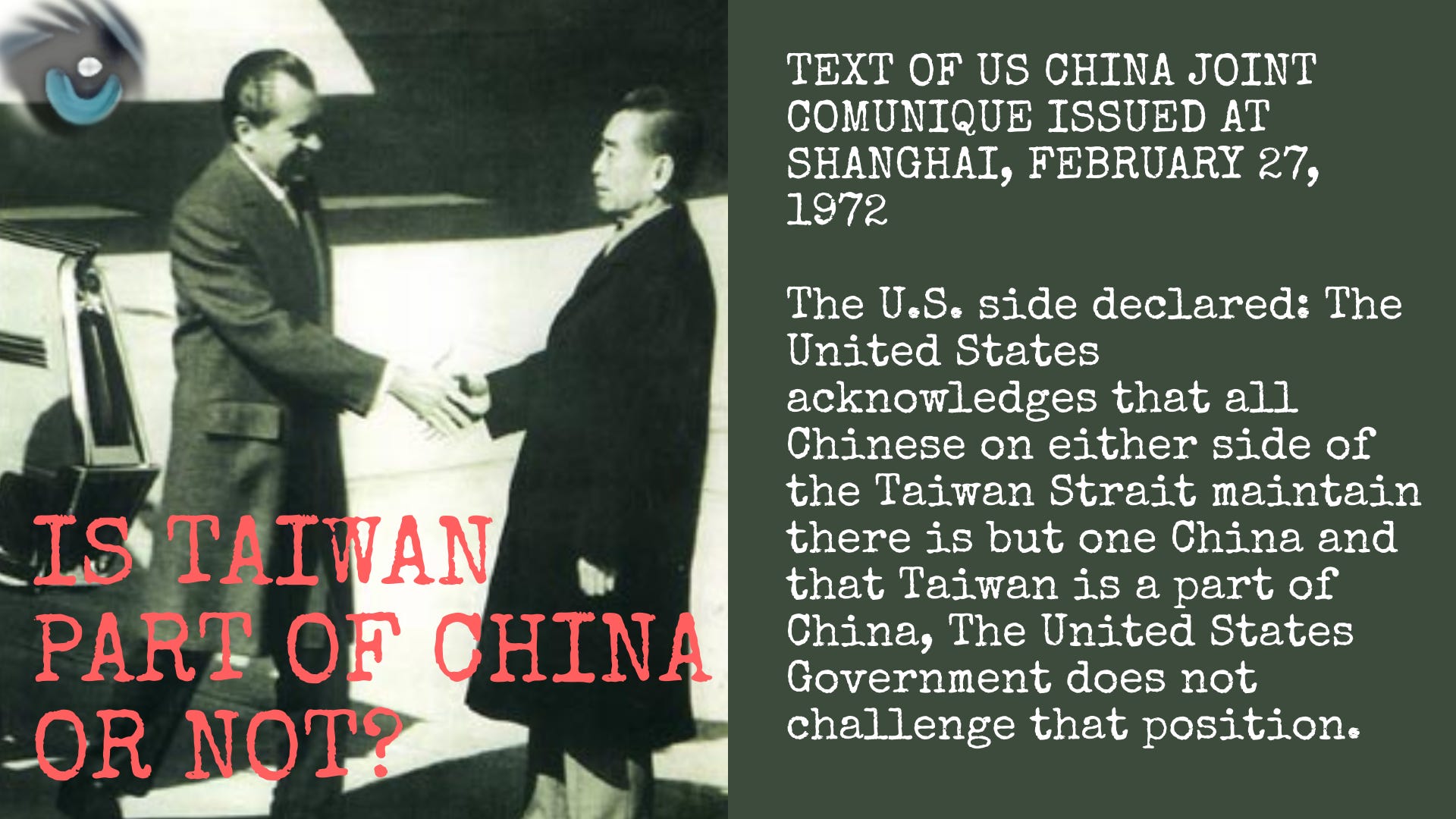
The United States — officially. Its One-China policy “acknowledges” the Chinese position that Taiwan is part of China. Washington does not recognise Taiwan as an independent country.
The United Nations. Resolution 2758 (1971) places the People’s Republic of China (Beijing) as the representative of “China,” which the resolution treats as including Taiwan.
The Cairo Declaration (1943) and Potsdam Proclamation (1945). Together they designated Taiwan to be returned to China after Japan’s defeat.
Governments that do NOT recognise Taiwan as an independent state: the United States, the United Kingdom, Japan, France, Germany, Italy, Spain, Poland, Canada, Australia, Russia, India, Brazil, and South Korea — and roughly 170 others, i.e. the vast majority of the world’s ~195 states.
Note: A small camp holds that Taiwan’s status is legally undecided — the 1951 San Francisco treaty had Japan renounce its claim without naming a recipient. It fits neither camp cleanly.
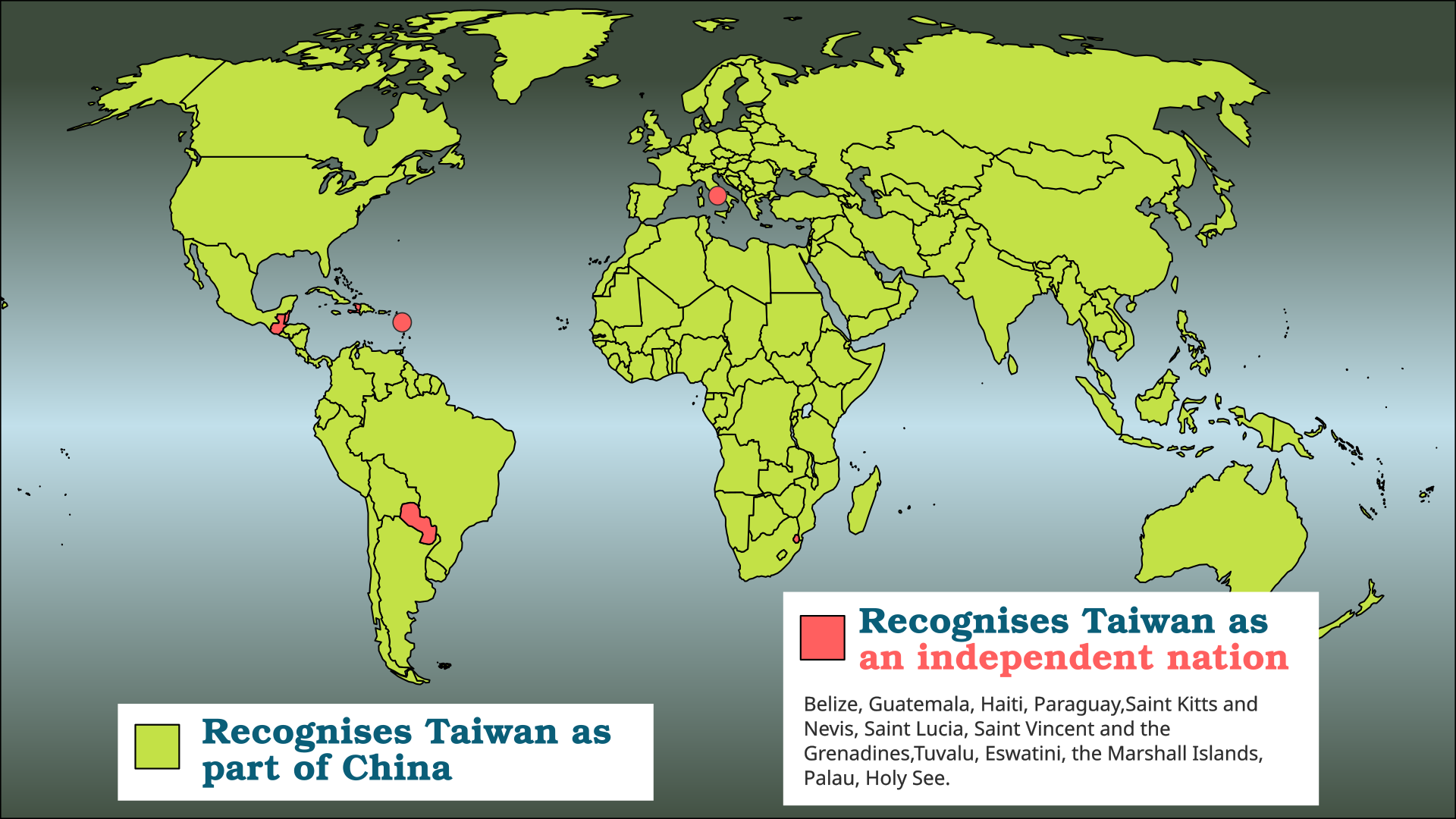
In summary, the YES camp has all the superpowers, the UN, and most of the world. The other holds a single political party — and the habits of Western media.
The “simple” version repeated in the West is the position held by almost nobody with a seat at the table, including Washington. This is the sleight of hand described in If You Wanted to Keep the World at War, a divided people presented as a single, unified victim.
The awkward fact is that nearly every official position says Taiwan is part of China is exactly the one the supporters of conflict must keep off the page.
See also: