

Three rivers flow into the post‑war American psyche, shaping everything that followed: the Vietnam War, the assassination of John F. Kennedy, and the unshakeable belief that communism was an existential threat to be countered, whatever the cost.
The Source
All three rivers can be traced to a single source, in a single week of November 1963: the coup in Saigon and the killing of South Vietnam’s leader, Ngo Dinh Diem.
It was Washington’s mirror moment — the instant it chose to kill its own reflection. Diem had been America’s creation: Catholic, anti‑communist, a modernist meant to embody Western virtue in Asian form.
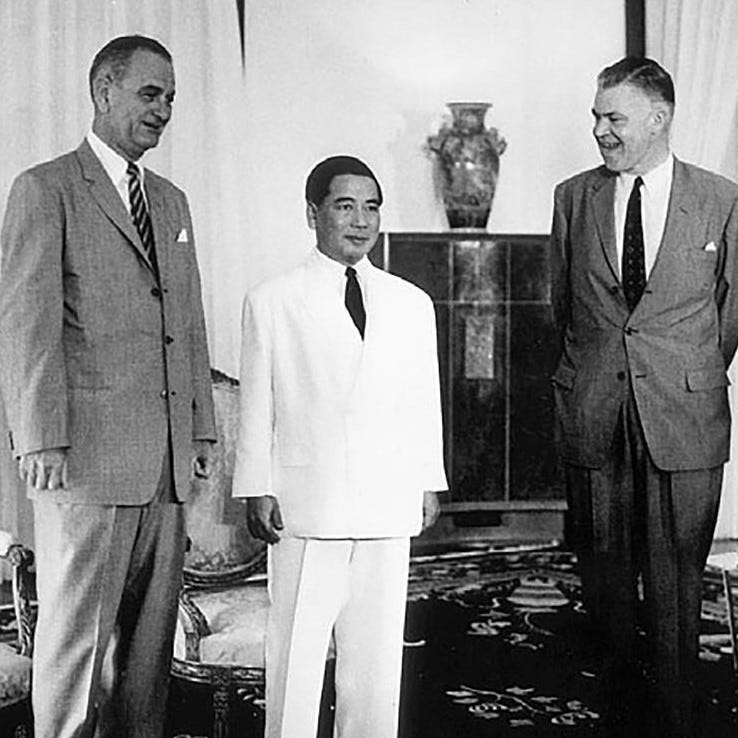
U.S. officials had long sponsored Diem’s brutality, but by 1963 the Vietnamese were disgusted with him, and even Washington found him unbearable. They convinced themselves that removing him would restore control.
When Diem and his brother were executed by CIA‑backed operatives in the back of an armoured car, the bullets and stab‑wounds didn’t just end a regime — they exposed the hypocrisy at the heart of Washington’s mission.
From that week onward, the United States was no longer exporting democracy or even defending business interests, as it had in Guatemala. It was generating chaos — and losing control.
Diem’s murder became the pattern for every later intervention — Vietnam, Iraq, Libya — each founded on the same delusion: that American moral superiority could be imposed through subterfuge and violence.
From a distance, the absurdity is obvious: how could covert killing ever be a force for good? In murdering its own puppet, Washington revealed its own incoherence. It appears as if the stage, the play, and the actors upon it, had all been misunderstood.
The Bureaucracy Takes the Wheel
The Saigon coup was never properly authorised. Between October and early November 1963, Washington’s machinery moved on its own momentum.
Ambassador Henry Cabot Lodge whispered one story to the generals; CIA officers spread another. Each presumed presidential approval. By the time doubts reached the Oval Office, events in Saigon had already slipped beyond the president’s control.
The State Department, the Pentagon, and the CIA were no longer executing policy — they were creating it.
The apparatus designed to serve democracy had instead, seized its power. After Diem’s death there was no turning back. A few discreet assassinations were cheaper than invasions, cleaner than debate, and infinitely easier to deny when things went wrong — as they soon did, horrifically, in Vietnam.
Kennedy seemed to sense the danger. Into his dictaphone he confessed, “I should not have given my consent to it,” referring to the memo that triggered the coup. His own government had killed an ally he had once personally befriended.
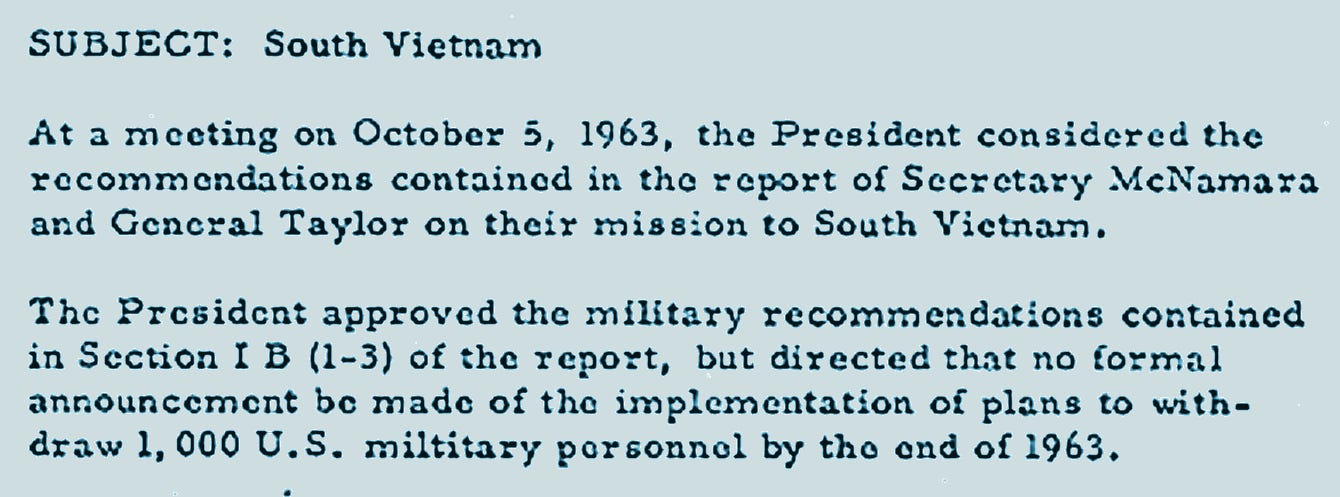
Perhaps one day Kennedy would have tamed the beast; he had reportedly said that he wished to “scatter the CIA to the winds.” But three weeks later, he too was dead. Within four weeks, his order to exit from Vietnam had been cancelled by President Lyndon Baines Johnson.
The Deep State Finds Its Voice
After November 1963, the institutions that had acted beyond presidential control carried on with little restraint. A new consensus hardened in Washington: presidents come and go, but “policy” must endure. The will of the electorate became secondary to the preferences of a permanent bureaucracy.
The entity we now call the Deep State had found its feet. The 1954 Guatemalan coup had been a corporate experiment; Saigon was a proof‑of‑concept that had spun catastrophically out of control. The result was the Vietnam War — millions dead, a nation divided, and America’s image of itself in ruins.
But Washington learned the wrong lessons. Instead of humility, it sought more power. Disaster was a merely a narrative. The control of perception replaced the pursuit of truth.
The Dream That Wouldn’t End
The three rivers — JFK’s assassination, the slaughter in Vietnam, and the manufactured fear of communism — merged into a single dark current that transformed the American soul.
A generation came of age believing their government had murdered their president, lied them into a war, and were generating unnecessary conflicts that could end the American way of life. Such suspicions were pushed below the surface, but never left. They mutated, hardened, and were passed on to the next generation in different forms.
Something terrible happened in 1963. It unfolded like a fever dream: an honourable republic sleepwalking into a corrupt empire, guided by illusions and haunted by suppressed guilt.
More than half a century later, America is still trying to wake up.